The latest happenings in renderling-land
Thu 01 Oct, 2026🔗
wgsl-rs beta released on crates.io🔗
I finished all three milestones and then some to
bring wgsl-rs to beta. It's not up on crates.io.
Read the release retro article for details.
More renderling manual articles🔗
I've added a number of articles to the manual:
Fri 29 May, 2026🔗
First wgsl-rs milestone complete🔗
The first milestone for wgsl-rs is done!
Generics!
The initial generics implementation landed, allowing WGSL functions and types to be parameterized.
This was a tricky feature, and I had a lot of internal back and forth about how far to take it.
When I first started the project I decided I would not tackle generics.
Then I started talking to Bevy engineers (primarily ncthbrt in this issue)
about the possibility of using wgsl-rs in Bevy and I realized that generics would significantly improve that effort.
Progress rewriting crabslab for wgsl-rs was also tricky without generics.
The API would have had to change dramatically without it.
Those factors combined were quite a heavy thumb on the scale in favor of shipping some sort of generics support.
As far as the implementation goes - the main change is that the proc-macro that underlies
wgsl-rs no longer emits const static strings.
Instead it builds up a WGSL IR AST which include generic parameters.
The paramaters can be instantiated at runtime from the CPU, which then monomorphizes
your shaders and outputs the WGSL as a string.
This obviously has trade-offs.
Primarily we lost compile-time naga validation.
But this feature was already only available if your module was written without imports, so it's no big loss.
The Rust code still passes through untouched, so this IR is still a strict subset of Rust.
Exhaustive roundtrip tests
Two PRs
landed with exhaustive roundtrip tests for WGSL builtins.
These ensure that code compiled through wgsl-rs and run on the CPU produces the same
results as the equivalent WGSL running on the GPU.
Extensions: derive macros for WGSL🔗
I've designed a solution for extensions that will make it possible to provide derive macros
on WGSL types. This opens the door for a plugin ecosystem around wgsl-rs, where crates can
provide custom derives that hook into the WGSL code generation pipeline.
Writing an "extension" requires writing a derive macro for the Rust side and then implementing
a trait to provide the WGSL side.
I expect writing extensions for wgsl-rs to be about twice the effort of writing derive macros
for Rust alone, but at least there's a solution.
Stars on github🔗
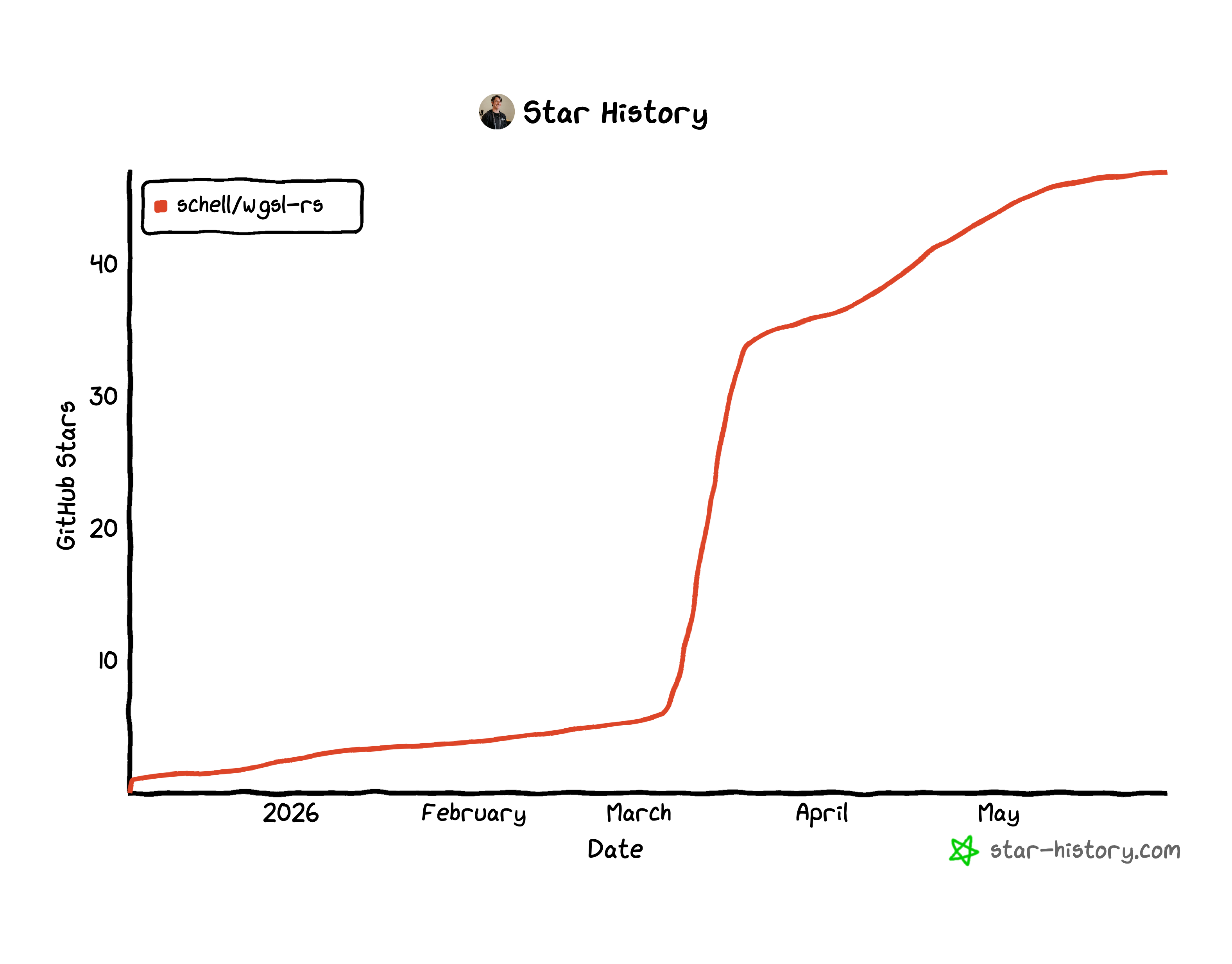
After the introductory article went live, wgsl-rs saw a
solid uptick in GitHub stars.
It's encouraging to see interest from the Rust gamedev community.
Bevy discussions🔗
I've been chatting with Bevy developers about whether wgsl-rs could serve as the shader layer for
the Bevy game engine.
It's early days and entirely likely this won't pan out, but the conversations have been productive
and it's exciting to explore the possibility.
See the discussion thread on the Bevy Discord render-dev channel.
Search for "wgsl-rs".
What's next🔗
I'm polishing for the initial release of wgsl-rs, including writing a layout extension and creating documentation.
After that I'm dogfooding the library to re-re-write crabslab with generics.
Happy hacking! 🙇☕
Sun 22 Mar, 2026🔗
wgsl-rs first milestone almost complete🔗
I've been working hard on the first milestone of wgsl-rs, which is essentially to get it feature complete.
All WGSL vocabulary is now supported (WGSL "std" library including built-in functions, types, texture sampling),
excluding extensions.
The last step is including exhaustive roundtrip tests for builtins to ensure the CPU runtime is coherent with the GPU.
New revamped 2d UI stuff🔗
I've revamped the 2d renderer. It now has its own shaders, which are much better fit for purpose.
Next on the roadmap for the 2d renderer are events, hit testing, sprite sheet animations and 9-slice buttons.
Other accomplishments🔗
Welcomed a contribution from m0ppers for GLTF animations, thank you 🙇!
improved formatting and CI cache situation
Thu 5 March, 2026🔗
Getting close with wgsl-rs, significant work on crabslab adaptation🔗
wgsl-rs
I've almost wrapped up the initial build out of wgsl-rs.
The last bit is the derivative builtins (dpdx, dpdy, fwidth, etc.) and
the discard statement.
I really don't know what I'm going to do for the CPU semantics of the discard statement yet.
Maybe something like return Default::default()? That might work?
Anyway - I took a break from furiously pawing at my keyboard to produce code this weekend to furiously paw at my keyboard to write an article introducing the library.
Please check out the article introducing wgsl-rs.
crabslab
Both crabslab and craballoc are successfully using wgsl-rs in a branch.
Once wgsl-rs is on crates.io as a beta release, I'll do beta releases of those as well.
...
That's all the news that's fit to print :)
🙇☕
Wed 11 Feb, 2026🔗
2026 NLnet Funding is Official🔗
The Memorandum of Understanding for the Renderling Ecosystem project has been signed with NLnet under the NGI0 Commons Fund. This makes the second year of NLnet funding official, and I'm excited to get started on the work ahead.
A New Direction: Embracing WGSL🔗
The biggest change in this round of work is that Renderling will be moving away from Rust-GPU and toward tighter integration with WebGPU and WGSL.
To support this, I've started work on wgsl-rs,
a procedural macro crate that lets you write WGSL shaders in a subset of Rust.
Code written with wgsl-rs runs on the CPU in Rust and on the GPU via
generated WGSL — same types, same logic, fully testable. It works on stable
Rust, produces human-readable WGSL output, needs no custom toolchains and even
generates wgpu linkage for you!
The funded milestones will take wgsl-rs to a beta release on crates.io, then
adapt crabslab and craballoc to work with it, and finally rewrite
Renderling's internals on the new stack.
GPU ECS: podecs🔗
Part of the funded work is a new crate called podecs — a GPU-accelerated
Entity Component System where components are plain old data defined with
wgsl-rs, stored in GPU-accessible slabs, and systems run as compute shaders.
This is the piece that makes massively parallel scene management possible and
lays the groundwork for what comes next.
The Road to Global Illumination🔗
The second half of the project focuses on rendering. The plan is to build a GPU ray tracer first, validate it against a reference image suite, and then adapt it for real-time performance using techniques like wavefront path tracing and raymarching. The end goal is real-time global illumination integrated with Renderling's existing lighting system.
Rend3 Compatibility🔗
Rend3 has been an important renderer in the Rust ecosystem, and there are projects out there that depend on it. Part of this funded work includes designing and implementing an API compatibility layer for Rend3 users, along with a migration guide and example programs. If you have an existing Rend3 project, Renderling aims to be a viable path forward.
What's Next🔗
I'll be working through these milestones over the course of the year and posting updates here as things progress. If you're interested in contributing or just following along, check out the repos:
Sun 30 Nov, 2025🔗
The past two months I've been pretty slammed with my new job and family stuff, but I've still been working on this project, albeit a bit sporadically.
crabslab changes🔗
I've managed to get a large PR finished on crabslab
that provides synchronization of values changed by shaders on the GPU back to
their CPU caches.
This change has been a long time coming, and it unlocks a lot of potential for interesting changes in Renderling, and beyond.
Specifically these changes help in any situation where a shader computes some data that then gets used on the CPU. And it does that with a minimal number of writes to and from the GPU.
This is all part of a grand scheme to blur the lines between GPU and CPU, and make GPU programming easier, which is essentially the main goal behind next year's worth of Renderling work.
2026 NLNet project🔗
Renderling was selected for another year of funding by NLnet. I'm currently working on the project plan and we have double the funding of last year, which means I'll be able to take on paid contributors and get more accomplished in the same amount of time.
Next year's work is focusing on the ecosystem and then riding that rising tide towards global illumination.
Global illumination is a very lofty goal, especially for a renderer that targets the web, but I think we can get there with some key tradeoffs.
Wed 24 September, 2025🔗
I've pushed the lighting chapter of the manual live.
Part of this was fixing a bug in image based lighting regarding bindgroup invalidation.
Sun 21 September, 2025🔗
I've done a rework of the API, greatly improved the documentation and created a user's manual full of examples. See the PR for the API change and initial manual w/ examples here.
I've also made somewhat drastic website changes:
The manual is now hosted here!
The docs are now hosted here!
The devlog is deprecated in favor of this news page.
The devlog is no more🔗
I'm moving away from the super long devlog format to something that hopefully is a bit more focused.
Now the devlog is broken up into two "things":
Small news blurbs on this "news" page.
Long-form stream of consciousness "devlog" articles for specific features that might span multiple days, weeks, or months.
why
The devlog was getting huge, and it's a bit too chaotic. Now I'll be live-blogging feature development in specific articles, like I did for Light Tiling, Live. I'm hoping this does a better job of keeping the devlogs on-topic instead of being a big jumble of different things.
All other blurbs are news, so they can live on the news page. I'm just trying to stay organized as this project grows.
But - the old devlog will stay where it was, at devlog, for posterity and so the links still work.
User's manual🔗
The manual covers the basics, but lacks lighting examples.
Obviously it's a work in progress.
I'll be making sure that it's complete after getting it online. Even in its incomplete state, it has lots of workable, tested examples in it, and I hope it helps folks get up and running with the library.
Documentation updates🔗
There's a ton more documentation coverage. I did a big audit of the current documentation and added more where needed as well as revamped the existing docs.
The latest docs are now hosted here at /docs, due to the fact that Renderling
depends on a not yet released version of spirv-std, which the Rust-GPU group is still
working on releasing.
API changes🔗
I've removed the crabslab::Id and craballoc::Hybrid* types from the public API.
I figured that it shouldn't be necessary for users to understand anything about slabs and descriptors.
Builder patterns
Now all the various resources (Primitive, Material, Vertices etc) adhere to a builder
pattern for configuration and updates.
Skybox is now separate from Ibl.
Up until this point, if you wanted to render a skybox, that skybox would also perform image based lighting automatically. I decided to decouple these now, as there are valid situations where you may not want IBL, but do want a skybox.